Calendar
RBH Casavant Organ Opus 3055, 1969: 43 stops, 64 ranks, 3105 pipes
Programme
Prelude and Fugue in G Major, BWV 541 – J.S. Bach (1685-1750)
“Impromptu,” from 24 Pièces de fantaisie, Op. 54 – Louis Vierne (1870-1937)
Psalm Prelude on De Profundis, Set 2, No. 1 – Herbert Howells (1892-1983)
Trio Sonata No. 6 in G Major, BWV 530 – J.S. Bach
i. Vivace ii. Lento iii. Allegro
“Jesus Loves Me,” from Gospel Preludes, Book 2 – William Bolcom (b. 1938)
“Dieu Parmi Nous,” from La Nativité du Seigneur, No. 9 – Olivier Messiaen (1908-1992)
For church organists who need to know the basics of tuning and fixing simple problems on their instrument.
J.S. Bach’s monumental Orgelbüchlein (BWV 599−644) is a collection of 46 Lutheran chorale preludes for organ, spanning the entire traditional liturgical year. As Bach composed these various chorale preludes mainly throughout his Weimar appointment from 1708-1717, the Orgelbüchlein is a showcase of his development as a composer through this early period of his career, as well as the development of the chorale prelude form as a whole. Several of the pieces within the Orgelbüchlein have stood as being among the most popular pieces in the organ literature, with many receiving transcriptions for other instruments (famously, Ferruccio Busoni’s transcriptions for solo piano, and Leopold Stokowski’s transcriptions for orchestra.) This concert will present the Orgelbüchlein in its original form, for solo organ.
Ballo del Granduca – Jan Pieterszoon Sweelinck
Praeludium in G minor (BuxWV 148) – Diedrich Buxtehude
Récit de Tierce en Taille (from Organ Mass) – Nicolas de Grigny
Three movements from Voluntaries – John Stanley
Largo – Andante – Allegro
Two Preludes from the ‘Leipzig Chorales’ – J S Bach
Schmueke dich. O liebe Seele (BWV 654) – Komm Heiliger Geist (BWV 651a)
Fantaisie in A – César Franck
Suite (First performance) – John Mitchell
Fanfare – Folk Tune – Sarabande –-Toccata
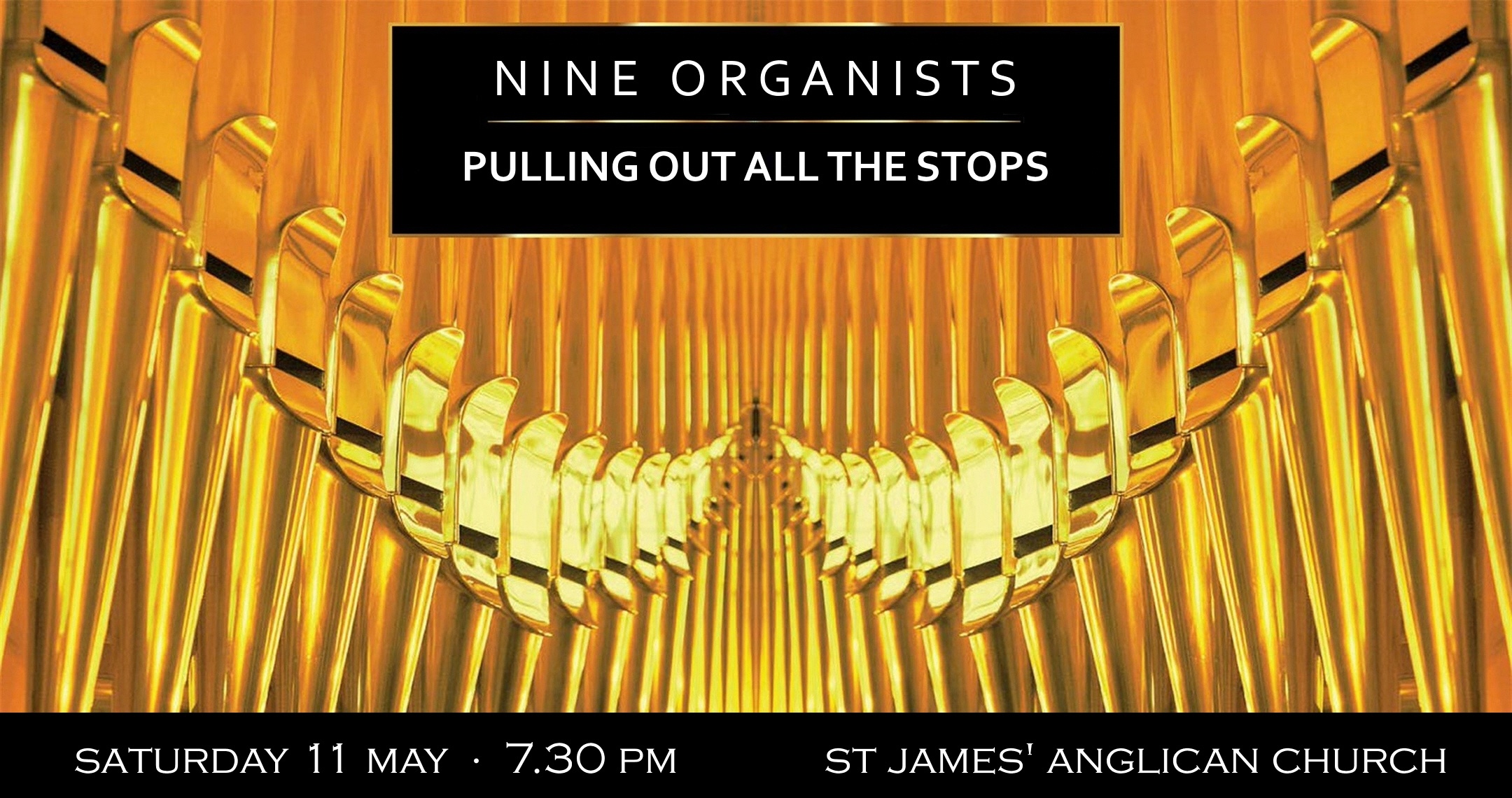
Performers and programme:
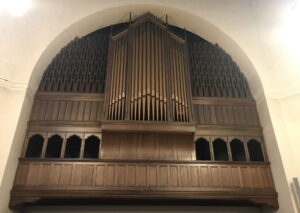
In 1938 Casavant Frères of St Hyacinthe, Québec, was awarded the contract for a new 3-manual organ of 1760 pipes. The organ itself was located in the north transept of the church, formerly the choir gallery, which was lowered to make room for the instrument, with a façade designed by Adrian Gilbert Scott — the same architect who designed St James’ Church building. Over the years some minor changes were made to meet the musical demands of a living church, including a new Choir division with three ranks in the west gallery in 1948, and a new organ console in 2003. With the addition of the Choir division, the organ now has 33 ranks and just under 2000 pipes. The main organ is located high on the north gallery of the church – an excellent location, as the grand sound of this fine Casavant Frères organ is marvellously enhanced by the church’s outstanding acoustics.

| A service and concert in memory of Alan A. Lowe, a beloved member of the St. Andrews-Wesley community. This concert and celebration of life service, featuring the complete Requiem by Gabriel Fauré and performed by the Sacred Voices Ensemble at St. Andrew’s-Wesley United Church, is open to the public, according to his last wishes. St. Andrew’s-Wesley’s choir of 16 professional singers will also be performing Tomás Luis de Victoria’s O Magnum Mysterium, and John Tavener’s beautiful Song for Athene, which became well-known after being performed at the late Princess Diana’s funeral. The Sacred Voices Ensemble will be led by St. Andrew’s-Wesley’s Choral Director Peggy Hua and accompanied by Director of Music Angelique Po on the organ and piano. |
Charlie Chaplin: His New Profession
Three hilarious shorts from Chaplin’s early years (1916 and 1917), featuring three of Vancouver’s own organists providing live accompaniment on the historic Wurlitzer organ, with literally all the bells and whistles!
The Fireman, with organist Michael Dirk
The Floorwalker, with organist Isaac Howie
The Adventurer, with organist Koos van Nieuwkoop
Info: https://vancouvercivictheatres.com/events/silent-movie-mondays-charlie-chaplin-shorts-jun-3-2024/
From the CRMSS (Canadian Renaissance Music Summer Schools) website:
New this year, CRMSS Pacific 2024 will include the opportunity for keyboard players to explore Renaissance instruments, historical playing styles, and music of the period with Christina Hutten of the University of British Columbia as instructor. Some of the events we are planning for participants in Keyboard Day include:
- Demonstration and Masterclass at West Vancouver United Church
- Stringed Keyboard Instrument Encounter and Masterclass
- Workshop on Keyboard in Renaissance Ensemble Music
- Lecture Recital: Sights and Sounds of Renaissance Italy’s Surviving Keyboard Instruments
- Potential Class on Renaissance Instrumental Music in a Liturgical Context
We have extended our application period for instrumentalists. Applications from players are still being accepted (as of May 24).
Instruments
We are very lucky to be able to offer the opportunity for keyboard players to hear and play the following instruments:
- At West Vancouver United Church, we have access to a mechanical action organ built by Martin Pasi of Roy, Washington after historical Dutch and North-German models.
- Although this is a versatile instrument built to serve the needs of a modern congregation, many aspects of its sound, touch, and construction allow for rich exploration of Renaissance organ music.
- Single-strung Italian harpsichord built by Colin Booth after an instrument by Domenicus Pisaurensis, early 16th century.
- Double-strung Italian harpsichord (short octave) built by José Verstappen after late 16th century models.
- Flemish single manual harpsichord built by Hubert Bédard, quilled in quill, after Ruckers single manual (1644).
- A collection of virginals built by Craig Tomlinson after Ruckers (1640).
Repertoire
Students are welcome to bring Renaissance repertoire from all over Europe to work on in masterclasses. Here are a few composers to consider: Jehan Titelouze, Thomas Tallis, William Byrd, Orlando Gibbons, Peter Philips, Thomas Weelkes, Jan Pieterszoon Sweelinck, Arnolt Schlick, Conrad Paumann, Paul Hofhaimer, Elias Nikolaus Ammerbach, Marc Antonio Cavazzoni, Girolamo Cavazzoni, Andrea Gabrieli, Giovanni Gabrieli, Claudio Merulo, Giovanni de Macque, Giovanni Maria Trabaci, Antonio de Cabezon, or Girolamo Frescobaldi. There are also many anonymous compositions to be found in collections like the Faenza Codex or Buxheimer Orgelbuch, and the publications of Attaignant and others.
Possible extension
Additionally, advanced players of historical keyboard instruments will have the opportunity to extend their participation in CRMSS Pacific 2024, allowing for a deeper dive into Renaissance keyboard music and ensemble playing skills over the course of a few days.
Level of experience required
The activities of Keyboard Day are open to lovers of historical keyboard music of every level. All participants will have an opportunity to play the historical keyboard instruments and participate fully in workshops, but masterclass slots will be offered on the basis of audition, arranged after your application to attend CRMSS Pacific 2024 is successful. Students wishing to participate as a keyboard player beyond Keyboard Day should be professional-track students or professional players of organ or other keyboard instruments.
How to apply to come to Keyboard Day
All applicants to CRMSS Pacific 2024 use the same application form, be they a singer or an instrumentalist. Please go to our How to apply to attend CRMSS Pacific 2024 page for more information and a link to the online application form.
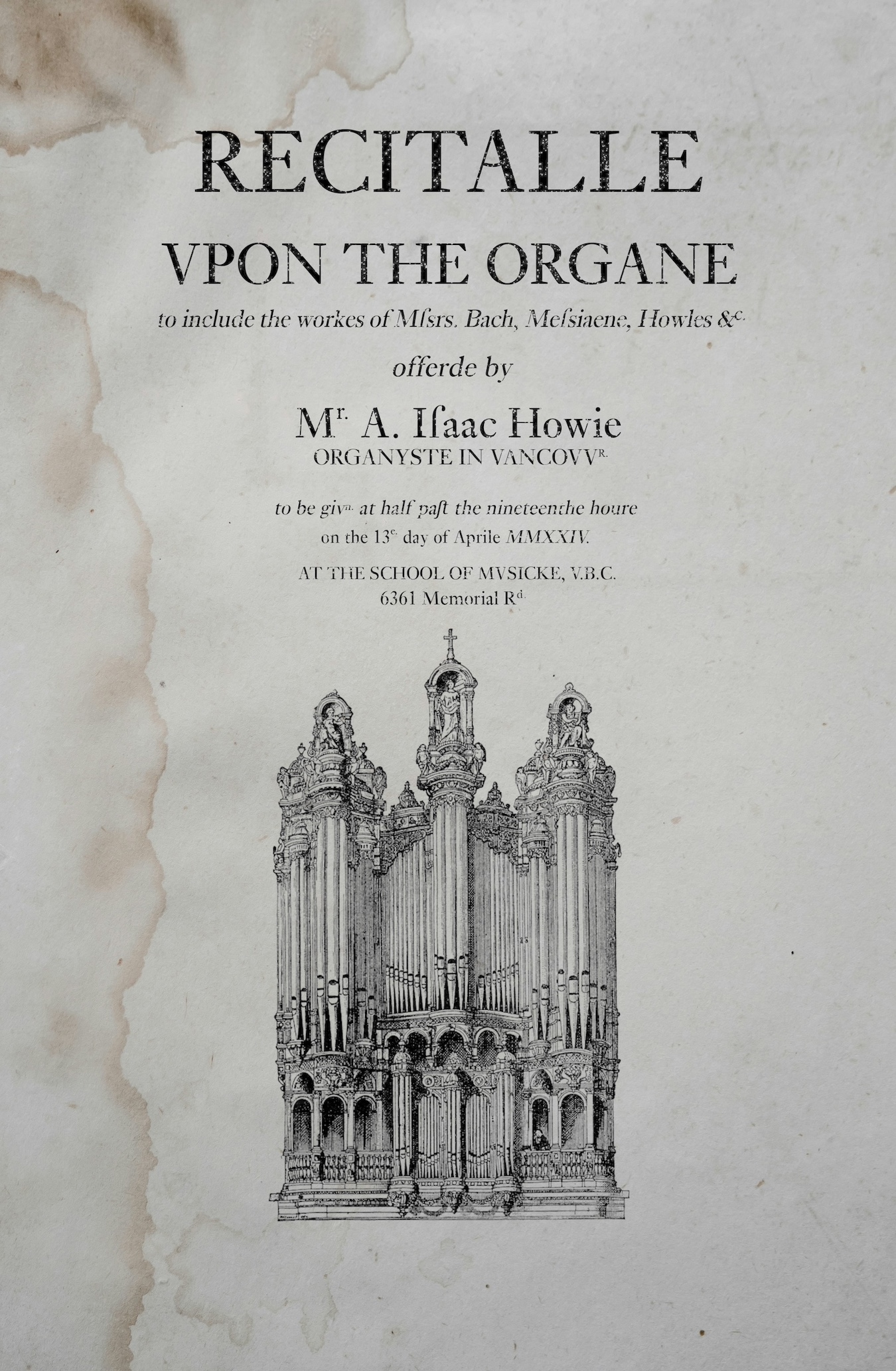
Isaac will be competing in the second Feith Organ Competition in Blieskastel, Germany in late August, and will showcase the competition repertoire in this recital. You are warmly invited to come and encourage him!
The competition describes this year’s theme as follows:
‘Under the motto “Organ music between tradition and modernity” we want to showcase the artistic diversity of the organ in 2024 with works by Jehan Alain, Anton Heiller, Maurice Duruflé and Theo Brandmüller.’
